
A digital form not only changes the way companies collect and manage information: it has also become a strategic tool for moving towards more sustainable production models.
Its adoption is not limited to the elimination of paper, but has a direct impact on the achievement of ESG objectives, a priority challenge for any industrial sector.
When a process goes from manual to digital, not only does the physical support disappear. It also optimizes time, reduces travel, avoids reprocessing and increases the capacity for anticipation. Each of these improvements translates into a more responsible consumption of resources, contributing to a more sustainable industry.
Beyond efficiency: the environmental value of the digital form
In the post Main benefits of digital forms for companies we already analyzed the main advantages of forms for companies. However, this time we are going to focus on the direct contribution to sustainability of digital forms.
By helping to achieve sustainability goals, digital forms enable companies to:
- Comply with decarbonization and environmental responsibility objectives.
- Advance in sustainability certifications and audits.
- Strengthen its corporate reputation with customers, investors and regulators.
In this sense, the adoption of a digital form is a decision that goes beyond efficiency: it is a commitment to innovation and to the planet.
Thus, a digital form is much more than a data capture tool. It is a strategic resource that drives efficiency, productivity and, above all, sustainability.
Each digitized process means less resource consumption, fewer emissions and greater control of environmental impacts. Thus, digital forms become a key ally for any industry that aims to reduce its social and environmental impact.
How a digital form helps reduce emissions
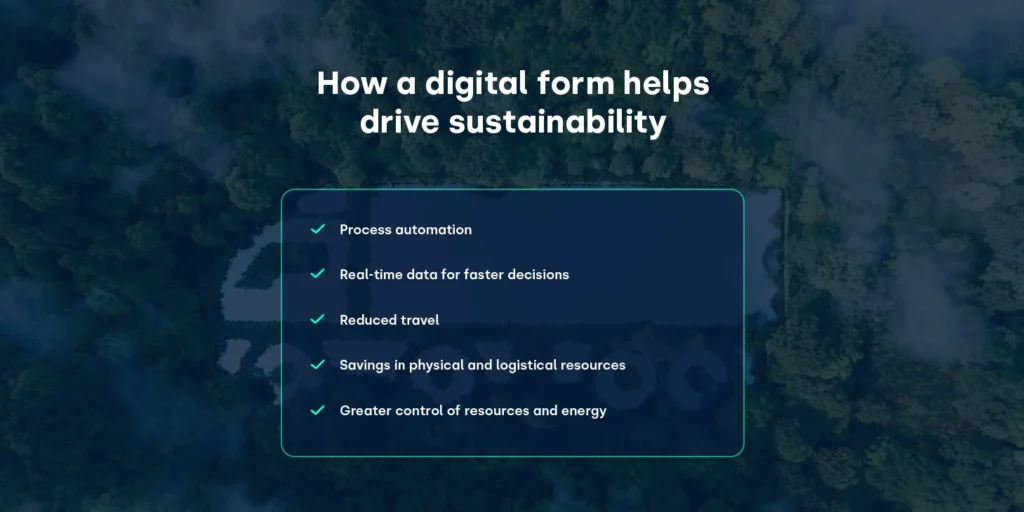
The sustainability of a digital form is based on a combination of efficiency and intelligent control. These are some of the key mechanisms that explain its contribution:
- Process automation: by eliminating redundant tasks and validating information from the source, energy expenditure due to errors and subsequent corrections is avoided.
- Real-time data for faster decisions: Having immediate information allows you to adjust energy consumption, redesign logistics routes or detect faults before they generate additional costs.
- Reduced travel: inspections, controls or audits that previously required physical presence can now be resolved in the field using mobile devices, eliminating internal and external trips that involve fuel consumption.
- Savings in physical and logistical resources: going paperless eliminates impacts associated with ink, printing, transportation and storage, as well as waste management.
- Greater control of resources and energy: with digitized data, it is easier to identify waste patterns, apply corrective actions and optimize resources throughout the value chain.
Thus, a digital form is not a simple substitute for paper, but a direct lever to reduce the environmental footprint of any organization.
Use cases with a positive impact on carbon footprint
Examples of the application of a digital form in different sectors show how this type of tool has a direct impact on sustainability:
- Manufacturing: digital inspections avoid unnecessary machine downtime, reducing energy consumption and production waste.
- Logistics: digital checklists for deliveries or maintenance allow to optimize routes and avoid additional kilometers in transportation.
- Construction: on-site supervision through digital forms eliminates documentation transfers, accelerates decision making and reduces reprocesses that generate costs and emissions.
- Energy and utilities: the digitization of inspections facilitates the early detection of leaks or failures, avoiding losses that increase environmental impact.
In all these cases, the common denominator is the same equation: less travel, less waste and smarter use of resources.
In the post Digital forms for different business sectors we analyzed the different applications of a digital form depending on the sector.
Best practices to maximize the environmental impact of the digital form
Adopting a digital form is the first step, but for carbon footprint reduction to be tangible, good practices should be applied in its design and deployment:
- Optimize the structure: agile forms, with relevant fields and conditional logics, reduce time and volume of processed data.
- Efficient synchronization: scheduling data delivery and updates at appropriate times helps reduce energy consumption on servers and networks.
- Continuous measurement: including environmental metrics linked to digitization makes it possible to demonstrate real progress in sustainability.
- Team training: a digital form only achieves its full potential if users use it correctly, avoiding errors and reprocessing that consume unnecessary resources.
How FIELDEAS Forms helps drive corporate sustainability
FIELDEAS Forms digital form software, in addition to simplifying and optimizing field data collection in industrial environments, also drives the achievement of sustainability goals.
Some of the added values offered by FIELDEAS Forms are:
- Personalized and paperless forms: the creation of fully digital flows eliminates the use of paper and associated materials, reducing waste and logistics footprint.
- Mobile and offline operation: workers can record information from anywhere, even offline, avoiding unnecessary travel and optimizing the use of resources.
- Integration with business systems: the data collected is automatically synchronized with management systems, eliminating duplication and enabling analyses that help to optimize energy and material consumption.
- Enriched evidence capture: the possibility of including photos, geolocation, QR codes or digital signatures guarantees traceability without the need for physical support, simplifying audits and certifications.
- Scalability and adaptability: FIELDEAS Forms adapts to different sectors and regulations, ensuring that each company can digitize processes with a low implementation impact and tangible results in sustainability.
Thus, FIELDEAS Forms is configured as a strategic ally to help reduce the social and environmental footprint of the industry, helping companies to meet their ESG commitments while strengthening their competitiveness.