
In today’s business environment, where operational efficiency and traceability of information are critical competitive factors, the online form has become a key tool for capturing, structuring and analyzing data in real time.
However, many organizations still use it only as a digital substitute for paper, without exploiting its true potential: measurement through KPIs (Key Performance Indicators).
- Why an online form must be more than just a data collection channel
- Essential KPIs to optimize online form performance
- From measurement to value: how KPIs power decision making
- The role of automation and analytics in online form management
- How to define the right KPIs for your organization
- FIELDEAS Forms, the online form solution focused on KPIs
Measuring the performance of the digital forms themselves is what makes the difference between superficial digitization and a data-driven operational transformation.
So in this post we explore why KPIs are essential for online forms and how they can drive efficiency, quality and decision making in industrial and service sectors.
Why an online form must be more than just a data collection channel
The online form is not only an interface to enter information. In industrial environments (maintenance, inspections, logistics, quality control, automotive…) each form is a source of field data that reflects the actual status of the operation.
However, without clear metrics, that data loses value. Companies collect thousands of records a day, but if they do not measure how, when and how efficiently they are generated, they cannot detect bottlenecks, errors or patterns of improvement.
That’s why KPIs are the natural next step in digital maturity: they allow you to transform simple data capture into operational intelligence.
Essential KPIs to optimize online form performance
When defining indicators, it is not a matter of measuring for the sake of measuring. KPIs must be aligned with the strategic objectives of the business: productivity, quality, regulatory compliance or customer satisfaction.
Although an online form allows you to measure all these strategic objectives through the generation of reports and dashboards where you can analyze trends, graphs, etc., it is important that the forms themselves have KPIs that measure the completion rate, response times, error rates, productivity and validation time.
This step is essential when implementing for the first time a digital forms software in a company, as it will allow us to detect which are the points of improvement and analyze the productivity of data collection in the field.
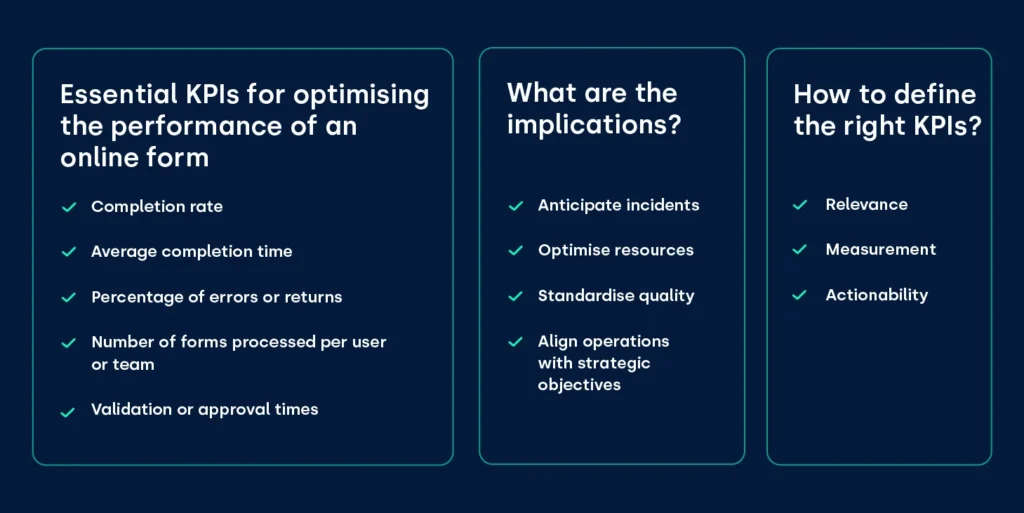
The following are some of the most relevant KPIs for online forms in business environments:
1. Completion rate
Measures the percentage of forms that are completed versus those that are initiated. A low rate may indicate that the form is too long, unintuitive or that users encounter technical obstacles.
Optimizing the user experience and simplifying the form structure can significantly increase this indicator.
2. Average completion time
In sectors where technicians must complete inspection or maintenance forms, time spent is a critical factor.
This KPI allows you to evaluate operational efficiency and detect repetitive tasks or unnecessary fields.
3. Percentage of errors or returns
If an online form has a high number of rejected or corrected records, it may be due to a lack of automatic validations, interface errors or deficiencies in the approval flow.
A good digital forms system should include quality controls and automatic alerts to reduce these failures.
4. Number of forms processed per user or team
It indicates individual or departmental productivity and allows to identify both the most efficient teams and the points where the workload is not balanced.
5. Validation or approval time
In processes where forms must be reviewed (e.g. safety reports or intervention parts), this KPI measures the time between delivery and final approval.
Reducing it directly impacts operational agility and internal customer satisfaction.
From measurement to value: how KPIs power decision making
Tracking KPIs in an online form allows you to visualize the operational health of your processes in real time.
Companies that adopt this approach achieve:
- Anticipate incidents: by detecting anomalies in timing or error rates, corrective measures can be implemented before they affect production.
- Optimize resources: knowing workflows and actual times helps to size teams and prioritize tasks.
- Standardize quality: objective measurement of compliance ensures consistency and adherence to procedures.
- Align operations with strategic objectives: KPIs translate daily activity into understandable metrics for management, enabling evidence-based management.
In short, measuring converts operational information into knowledge to improve the operational decision-making process.
The role of automation and analytics in online form management
Thus, having effective KPIs implies having a system capable of collecting, processing and analyzing data in real time.
Platforms such as FIELDEAS Forms allow centralizing the information captured from any device, integrating it with corporate systems and generating control panels that visualize key indicators.
Through configurable dashboards, managers can consult metrics such as fulfillment times, performance per technician or monthly productivity evolution.
In addition, flow automation reduces manual intervention and ensures that form data is validated, shared and archived without errors.
The result is an intelligent digital ecosystem, where each online form not only records information, but actively contributes to continuous improvement.
How to define the right KPIs for your organization
There is no universal set of indicators valid for all companies. The design of KPIs should be based on three fundamental principles:
- Relevance: each KPI must have a clear purpose and be directly linked to an operational or strategic objective.
- Measurement: indicators should be based on data that can be obtained automatically and consistently.
- Actionability: measuring only makes sense if the information obtained allows action and improvement.
With this in mind, a good practice is to start with a few critical indicators (e.g., completion time and error rate) and expand as you mature in your use of the online form.
The ultimate goal is for the data collected to generate a cycle of continuous improvement, where each process adjustment is based on quantitative evidence.
FIELDEAS Forms, the online form solution focused on KPIs
Implementing an online form should not be an end, but a means to gain visibility and control over operational processes.
Thus, KPIs allow companies to turn the capture of information into a strategic tool to improve productivity, quality and compliance.
Through platforms such as FIELDEAS Forms organizations can define, monitor and analyze the indicators that really matter, driving data-driven management and informed decisions. Because in the end, what you don’t measure, you can’t improve.
How FIELDEAS Forms works
FIELDEAS Forms online forms software has a drag & drop editor, which facilitates the design of customized or template-based forms, adapted to different use cases such as inspections, checklists or inventories, among others.
In this way, once the performance KPIs of the technical team have been analyzed, it allows us to adjust the forms in an agile and simple way to boost productivity and the flow of data collection in the field.
- Mobile and offline work. The app works on any device and allows you to complete forms even offline, synchronizing the data once the signal returns.
- Advanced data collection. The forms support multimedia captures (photo, audio, video), QR or bar codes, geolocation and signature, which enhances data quality, management and distribution.
- Real-time validation and automatic logic. Automatic rules applied when filling out forms ensure consistency and quality of data from the source.
- Instant reporting and decision making. Once completed, the data is processed instantly, generating automatic reports that allow real-time analysis and timely decision making.
- Integration with corporate systems. Thanks to its API, FIELDEAS Forms connects easily with other business systems and platforms, ensuring a continuous flow of information.
- Security and standardized data. The platform offers encryption of data in transit and in storage, under a standardized data model, which reduces errors and improves the reliability of the analysis.
- Scalability. Designed to adapt to various sectors and any business structure, regardless of the level of complexity of the business processes.
With all this, FIELDEAS Forms offers a comprehensive and agile solution to implement an online form that transforms workflows in the field, improves traceability and optimizes data management in any type of company.