
The digitization of industrial processes has led to an increasing use of digital smart forms. In this context, ensuring data security with smart forms is essential to ensure that the information captured in the field is reliable, complete and protected against unauthorized access.
Going for this type of solution is not only about complying with regulations, but also about ensuring that digitization brings efficiency without compromising data confidentiality.
Smart forms make it possible to record information from multiple devices and enrich it with images, geolocation, electronic signatures and other elements that optimize the traceability of processes.
However, this advanced capture capability also expands the risk surface, making it imperative to adopt robust security measures at all stages of information management.
What does data security with smart forms involve?
When we talk about data security with smart forms, we mean a holistic approach that protects information in three main dimensions:
- Integrity: guaranteeing that the information cannot be altered without leaving a record.
- Availability: ensuring that data is accessible when needed, even in environments with limited connectivity.
These dimensions are essential for the data collected to be reliable and useful for decision making, audits and regulatory compliance.
Risks associated with smart forms management
Despite their usefulness, smart forms can generate vulnerabilities if they are not implemented with clear security criteria:
- Data interception during transmission: if not properly encrypted, data can be captured by third parties.
- Loss or theft of devices: cell phones or tablets containing sensitive information are a point of risk.
- Regulatory non-compliance: failure to comply with regulations such as the General Data Protection Regulation (GDPR) can result in financial and reputational penalties.
- Lack of traceability: without clear records of who captured what data, auditing and process control is difficult.
Essential measures to ensure data security with Smart forms
To minimize these risks, smart forms incorporate a series of technical and organizational measures that reinforce data protection:
1. End-to-end encryption
End-to-end encryption ensures that data is protected throughout the data capture process, its transmission from the device to the server and while it is being stored. This prevents information from being read or modified without authorization.
2. Secure connections
The use of protocols such as HTTPS and digital certificates guarantees the authenticity of the servers and protects the communication against possible interceptions.
3. Storage according to regulations
Storing data on servers that comply with local and international regulations, such as GDPR, ensures that privacy and data protection standards are respected.
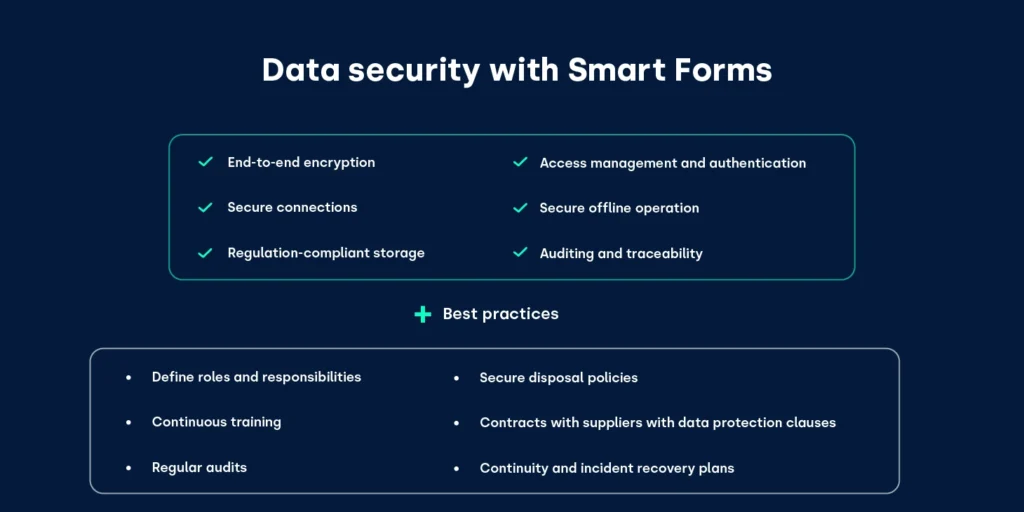
4. Access management and authentication
It is very important to decide who can view, modify or download information. To protect it, measures such as asking for various forms of verification when logging in and limiting what each person can do according to his or her role are used.
5. Secure offline operation
In industrial environments with limited connectivity, smart forms allow you to work offline while maintaining the same security guarantees, synchronizing data securely when the connection is re-established.
6. Audit and traceability
Recording metadata such as date, time, location, device and capture user facilitates auditing, incident resolution and regulatory compliance.
Best practices for companies adopting smart forms
Data security with smart forms is not only a technical or legal requirement: it is a key element of trust with customers, suppliers and auditors.
Proper information management strengthens the company’s reputation and allows it to operate with greater efficiency and transparency.
Thus, beyond technology, security depends on internal policies and organizational culture:
- Define clear roles and responsibilities for information management.
- Continuous training of personnel in the safe use of devices and applications.
- Periodic audits to identify vulnerabilities and strengthen controls.
- Secure data deletion policies for devices that are no longer in use.
- Contracts with suppliers that include data protection clauses.
- Incident continuity and recovery plans, ensuring access to critical data under any circumstances.
Adopting these practices allows smart forms to be not only efficient, but also reliable and secure.
FIELDEAS Forms, guaranteed data security with Smart forms
The differential value of the digital forms solution for the industrial environment of FIELDEAS Forms is that it guarantees data protection without the need for additional technical complications.
FIELDEAS Forms ensures data protection through a comprehensive approach from transmission to storage. The platform employs secure channels for information transmission and uses encryption to protect data both in transit and at rest.
Your information is always protected, without technical complications. Our no-code solution adapts to your company’s needs so you can focus on your processes, knowing that you are in good hands.
- Secure transmission via secure channel
- Encrypted storage to protect information on European territory
- Compliance with the General Data Protection and Privacy Regulation
- Robust (Tier IV approved) and reliable cloud infrastructure with access to our Saas