Inventory control is a critical point for many companies, since its correct management depends on operational continuity, avoiding losses and making informed decisions. In this context, the digital form for inventory control is no longer a simple alternative to paper, but a strategic tool.
More than an electronic format, digital forms represent a way to structure information accurately, speed up field verifications and provide a clear view on the availability and status of resources.
Adoption has become more widespread as companies seek streamlined processes and data that can be accessed and analyzed on the fly, without relying on transcripts, late reviews or scattered documents.
What is a digital form for inventory control?
A digital inventory control form is a digital solution designed to collect data related to stock, movements, location, status and usage of products or assets.
Digital forms such as FIELDEAS Forms can be used from any device (mobile, tablet or computer) and allow you to structure the information according to the criteria of the organization: identifiers, quantities, categories, locations, responsible persons and any other relevant field.
Unlike traditional paper forms, a digital inventory control form can be easily configured, updated and shared.
In addition, it integrates with analysis tools, ERP systems and automation platforms. The result is a more agile, secure and standardized process that reduces human error and ensures that any changes are time-stamped.
Advantages of implementing digital forms for inventory management
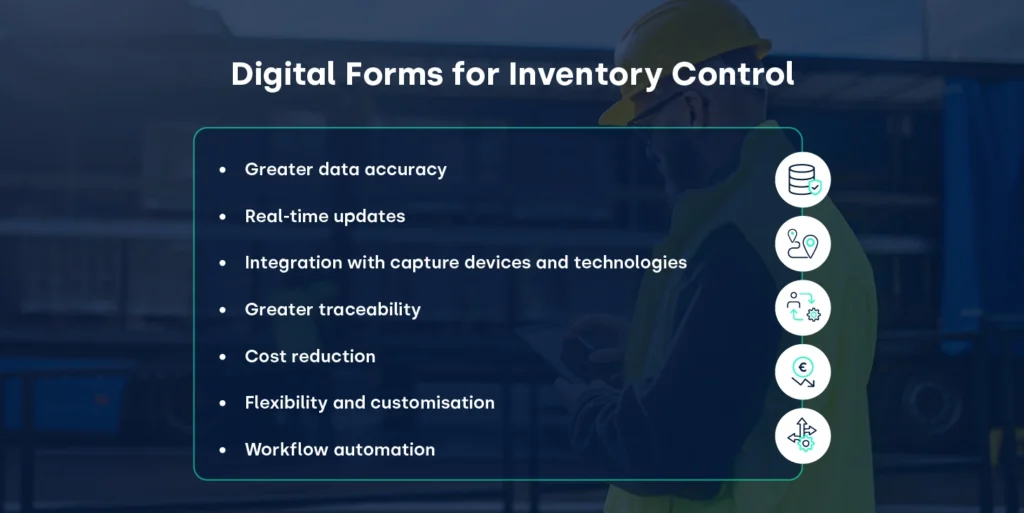
Adopting a digital form for inventory control brings tangible benefits from day one. Some of the most relevant advantages are:
Increased data accuracy
Manual capture on paper usually generates errors due to illegible handwriting, confusion of elements or loss of documents. With a digital form such as those offered by FIELDEAS Forms, the fields are filled in in a guided and validated way, which avoids inconsistencies and introduces automatic quality controls.
Real time update
Any record made from a device is immediately synchronized with the central database. This allows you to see the status of inventories instantly, without having to wait for shifts to close or for personnel to transcribe the information.
Integration with capture devices and technologies
A digital form oriented to inventory control can incorporate barcode reading, QR scanner, NFC technology or even image capture. This facilitates the identification of products, equipment or supplies and avoids typing errors.
Increased traceability
Every movement is logged with user, date and location. This level of traceability is crucial for auditing, compliance and performance analysis.
Cost reduction
The elimination of paper, physical storage and duplication of tasks through the implementation of intelligent forms such as FIELDEAS Forms reduces costs and frees up operational time.
Flexibility and customization
The forms can be adapted to different sectors, company sizes and internal processes. It is not a rigid tool, but a system that adjusts to the way each organization works.
Workflow automation
Through integrations with management systems, a digital form used for inventory control can generate alerts when stock reaches critical levels, initiate automatic orders or send reports.
Actual use cases of online forms for inventory control
Digital forms for inventory control are applied to a variety of processes in different sectors. Among the most relevant use cases are:
Equipment inventory
Maintenance, telecommunications, construction and technical services companies use digital forms to record the location, condition, serial number and usage history of their equipment.
Thus, a digital digital form applied to the control of equipment inventories allows to know which tools are available, which require maintenance and which elements are assigned to each worker or project.
On the other hand, it also facilitates the management of critical assets that must comply with safety or calibration protocols.
Inventory of products in warehouses
In logistics and distribution, digital forms allow recording incoming and outgoing goods, performing cycle counts and verifying differences between physical and theoretical inventory. In addition, the automatic reading of bar codes speeds up the process and avoids registration errors.
Read the post Online forms in transport and logistics: boost your digital transformation.
Inventory of raw materials in industrial production
Industrial plants need to control supplies such as chemicals, metal materials, spare parts or consumables to avoid line stoppages.
In this sense, a digital form used in production inventory control facilitates continuous monitoring and enables automatic replenishments to be triggered.
Inventory of technological assets
IT departments use digital forms to document computer equipment, software licenses, peripherals, mobile devices and network components. Digitization makes it easy to update service life, allocations and renewals.
Inventory for stores and points of sale
Retail stores use this type of form to control stock on shelves, check discrepancies and keep the sales system up to date. Real-time synchronization is useful to avoid stock-outs and improve the customer experience.
Inventory in transport and reverse logistics companies
The tracking of returnable packaging, containers, pallets or loading equipment can also be managed with digital forms, facilitating the traceability of items moving between branches or customers.
Key functionalities of a digital form for inventory control
A comprehensive system such as FIELDEAS Forms incorporates functionalities that optimize field work and administrative management. Among the most outstanding are:
Barcode and QR code reading
Operators can scan products directly from the device’s camera, filling out the form without the need to type long codes. This improves speed and reduces errors.
Capture of photographs
It allows documenting conditions, damage, packaging or evidence of stock. It is especially useful in inspections, material reception and equipment control.
Offline operation
When inventory control is performed in areas with poor coverage, a digital forms solution such as FIELDEAS Forms allows you to continue working offline and from any device.
Automatic geolocation
A digital form focused on inventory control can record the exact location of the device at the time of capture. This provides traceability in operations with mobile personnel or distributed inventories.
Automatic validations
The system can verify that required fields are complete, that numeric values make sense, or that an existing identifier is not repeated.
Digital signatures
In processes that require approval or operational responsibility, the integrated digital signature provides security and avoids the use of paper documents.
Integration with external systems
Collected data can be automatically sent to an ERP, asset management system or analytics platform, eliminating the need for manual transcription.
History and audit
Each modification is recorded for later consultation, facilitating internal or external audits.
In addition, by having a history , the solution automatically generates downloadable reports in PDF format that can be shared internally or with customers.
All in all, whether managing equipment, products, raw materials or technology assets, digital forms offer an orderly, fast and traceable way to manage information.
In an environment where data have become a strategic asset, having tools such as FIELDEAS Forms that guarantee their quality is essential to operate competitively and anticipate market needs.