
Data collection is a critical part of any business. In this sense, forms are fundamental tools for collecting information and approving processes. However, not all forms offer the same efficiency and security. The key difference is the digital signature.
- Differential values of digitally signed forms
- Information security and authenticity
- Integrated legal compliance
- Full integrity and traceability
- Flow optimization and advanced automation
- Reduction of errors and rework
- More agile and professional experience
- Scalability and adaptation to new needs
- FIELDEAS Forms, digitally signed forms for businesses
A digital form without a digital signature may improve speed over paper, but it still requires additional steps to validate the information, ensure its integrity and comply with legal standards.
On the other hand, digitally signed forms integrate security, traceability and legality within the digital flow itself, offering significant strategic advantages.
Differential values of digitally signed forms
Information security and authenticity
Digital forms without digital signature:
- The information is collected electronically, but there is no built-in mechanism to ensure that whoever completes or approves the form is really who they say they are.
- To validate authenticity, it may be necessary to send external confirmations or resort to manual processes.
Forms with digital signature:
- Each signature is linked to a digital certificate that uniquely identifies the signer.
- Any subsequent alteration to the document automatically invalidates the signature.
- The signature history is recorded and auditable, ensuring that the content has not been modified.
The digital signature converts a digital form into a reliable and legally valid document, eliminating uncertainty about the identity and integrity of the information.
Integrated legal compliance
Digital forms without digital signature:
- Although they are electronic, they do not automatically comply with legal regulations.
- To give them legal validity, it may be necessary to print them, sign them physically or use external authentication solutions.
Forms with digital signature:
- They comply with international regulations such as eIDAS in Europe.
- They allow digitally signed documents to have immediate legal validity, without additional steps.
Digitally signed forms ensure that documents are legally binding from the moment they are completed.
Full integrity and traceability
Digital forms without digital signature:
- Although they store data electronically, they do not always allow you to verify whether a document has been modified after it has been sent.
- Traceability depends on activity history, which may not be sufficient for audits or legal processes.
Forms with digital signature:
- The digital signature guarantees the integrity of the form, leaving an auditable record of who completed it, when and from what device.
- Facilitates internal and external audits, with reliable evidence of all actions performed on the document.
Thus, the online forms with signature favor greater control and confidence in the data, reducing the risk of fraud or alterations.
Flow optimization and advanced automation
Digital forms without digital signature:
- They allow automating some steps, such as storage or notifications, but often require manual processes to validate or approve the information.
- The lack of a digital signature can cause delays when official confirmation of a document is required.
Forms with digital signature:
- Once signed, additional automatic processes can be activated: sending to other departments, updating of databases, generation of certified copies, automatic notifications.
The digital signature enables a fully digital, fast and seamless flow, eliminating manual validation steps.
Reduction of errors and rework
Digital forms without digital signature:
- Errors in data or lack of confirmation may require subsequent corrections.
- Additional checks to validate information generate rework and delays.
Forms with digital signature:
- Automatic validations combined with the digital signature ensure that the data is correct and officially approved right from the start.
- Reduces the need for revisions, corrections and reprocessing.
Digital forms with signature ensure fewer errors, more reliable processes and savings in time and resources.
More agile and professional experience
Digital forms without digital signature:
- Although they eliminate paper, they can still generate friction by requiring additional external verification or confirmation steps.
- The digital experience is not complete if approval is not immediate and secure.
Forms with digital signature:
- They offer a complete flow, from data capture to legal validation.
- Users can complete, sign and submit the form in minutes, without relying on third parties or external processes.
The main advantage is that it streamlines the interaction and gives a sense of professionalism and reliability throughout the operation.
Scalability and adaptation to new needs
Digital forms without digital signature:
- Scaling up processes may require more manual checks or the integration of external authentication tools.
- Adapting to regulatory or internal changes involves additional processes and possible complications.
Forms with digital signature:
- They allow you to easily replicate, modify and automate workflows.
- The integrated digital signature ensures that any changes to the form still meet legal and security standards.
The solution is flexible, scalable and ready to grow with the company without losing efficiency or compliance.
FIELDEAS Forms, digitally signed forms for businesses
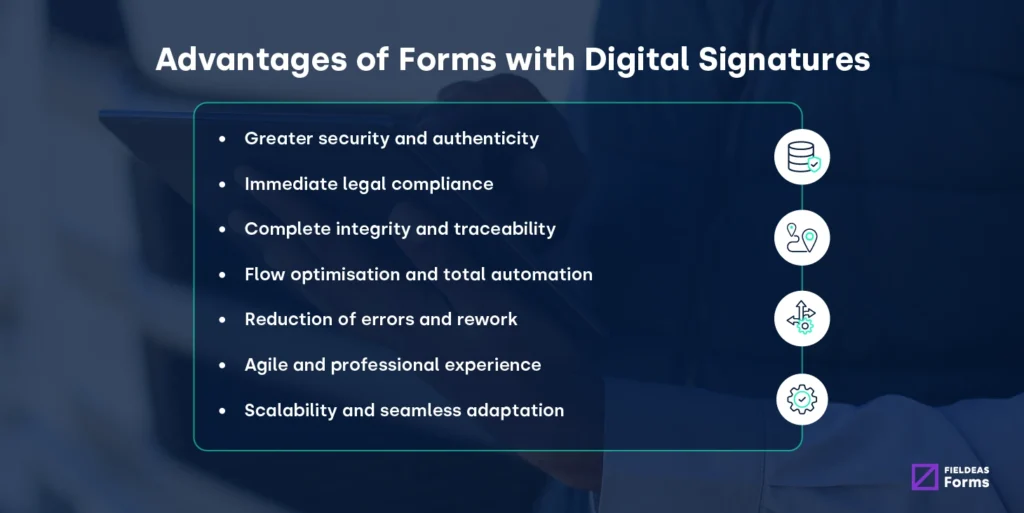
FIELDEAS Forms forms with digital signature offer clear advantages over digital forms that do not include this option:
- Increased security and authenticity.
- Immediate legal compliance.
- Complete integrity and traceability.
- Flow optimization and full automation.
- Reduction of errors and rework.
- Agile and professional experience.
- Frictionless scalability and adaptability.
While a simple digital form can improve certain processes over paper, the digital signature completes the digital flow, turning each form into a reliable, legally valid document ready to automate corporate processes in a secure and efficient way.
Adopting this technology is not only an operational improvement, but a strategic step towards more agile, secure and reliable processes, with a direct impact on the productivity and quality of the company’s data management.